How ISRO Makes Big Missions on Tight Budgets ? Explained
How ISRO Keeps Space Missions Low-Cost: Chandrayaan Case Study Explained
India’s space missions are often described as frugal, but that’s a bit misleading. They’re not cheap because corners are cut randomly—they’re cheap because of systematic design choices and institutional discipline. Chandrayaan is a great case study to see how this works in practice.
Below is a clear breakdown, with the trade-offs spelled out.
1. Mission goals are tightly scoped (no “nice-to-have” science)
Indian Space Research Organisation (ISRO) designs missions around specific, limited objectives.
Chandrayaan example
Chandrayaan-3’s primary goal was safe lunar landing and surface mobility
No orbital science, no sample return, no complex drilling
Instruments were few, focused, and largely proven
Cost impact
Fewer subsystems → less testing → less mass → cheaper launch
Smaller teams and shorter integration cycles
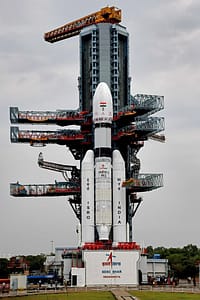
ISRO Rocket ready to launch
Trade-off
Less scientific output compared to missions like NASA’s Perseverance
Missions answer narrow questions very well rather than many questions broadly
2. Reuse of heritage technology instead of bleeding-edge hardware
ISRO strongly prefers flight-proven components, even if they’re less advanced.
Chandrayaan example
Lander software reused concepts from Chandrayaan-2
Propulsion systems were evolutionary, not revolutionary
Ground systems, tracking, and navigation reused existing infrastructure
Cost impact
Minimal redesign
Lower failure risk → less expensive testing and insurance margins

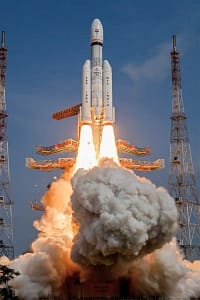
ISRO rocket at the time of launch
Trade-off
Lower autonomy and AI sophistication
Fewer “first-in-the-world” technologies
3. Vertical integration and in-house engineering culture
Unlike many Western agencies, ISRO:
Designs most systems internally
Uses public-sector labs and long-term vendors
Avoids heavy reliance on private prime contractors
Chandrayaan example
Navigation, propulsion, structures, and software largely built in-house
Contractors supply parts, not full systems with profit margins layered in
Cost impact
Salaries are fixed, not project-based
No cost-plus contracts inflating budgets

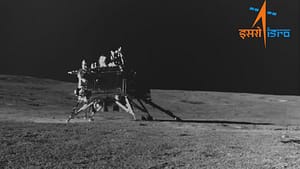
ISRO rocket landed on Moon
Trade-off
Slower scaling
Less rapid iteration compared to private-sector–driven models like SpaceX
4. Conservative testing philosophy (smart, not exhaustive)
ISRO does targeted testing, not maximum testing.
Chandrayaan example
Focused heavily on landing dynamics and propulsion
Less redundancy compared to NASA missions
Smaller margins for extreme off-nominal conditions
Cost impact
Testing is one of the most expensive parts of any space mission
Fewer test articles and simulations → major savings

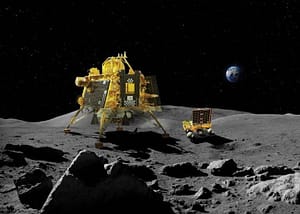
Earth view from Moon surface
Trade-off
Less fault tolerance
Higher dependence on correct initial assumptions
5. Lower labor and infrastructure costs — but that’s not the whole story
Yes, Indian salaries and facilities cost less—but that alone doesn’t explain the difference.
Chandrayaan context
Even adjusted for purchasing power parity, Chandrayaan-3 is still dramatically cheaper than comparable missions
Cost efficiency comes more from organizational structure than wages
Trade-off
Teams work with tighter timelines and fewer personnel
Less redundancy in human resources
6. Acceptance of “good enough” over “perfect”
ISRO optimizes for mission success, not perfection.
Chandrayaan example
Data rates were modest
Mission lifespan expectations were conservative
No over-engineering for extended missions
Cost impact
Lighter spacecraft
Simpler thermal and power systems
Trade-off
Shorter operational life
Limited ability to repurpose the mission after primary goals are achieved
Big picture: what Chandrayaan tells us
ISRO’s cost advantage comes from choices, not shortcuts
| Area | ISRO approach | Trade-off |
|---|---|---|
| Mission scope | Narrow & focused | Less science |
| Technology | Proven | Less cutting-edge |
| Testing | Targeted | Lower redundancy |
| Organization | In-house | Slower scaling |
| Philosophy | “Works reliably” | Not “best in class” |
Why this matters globally
ISRO has effectively proven that:
Space exploration doesn’t have to be billionaire-expensive
Emerging nations can run credible planetary missions
There’s room for multiple models of space programs: high-budget/high-capability and low-cost/high-efficiency